C7 Corvette Stingray: The Last Front-Engine Corvette Is Quietly Turning Into a Collectible
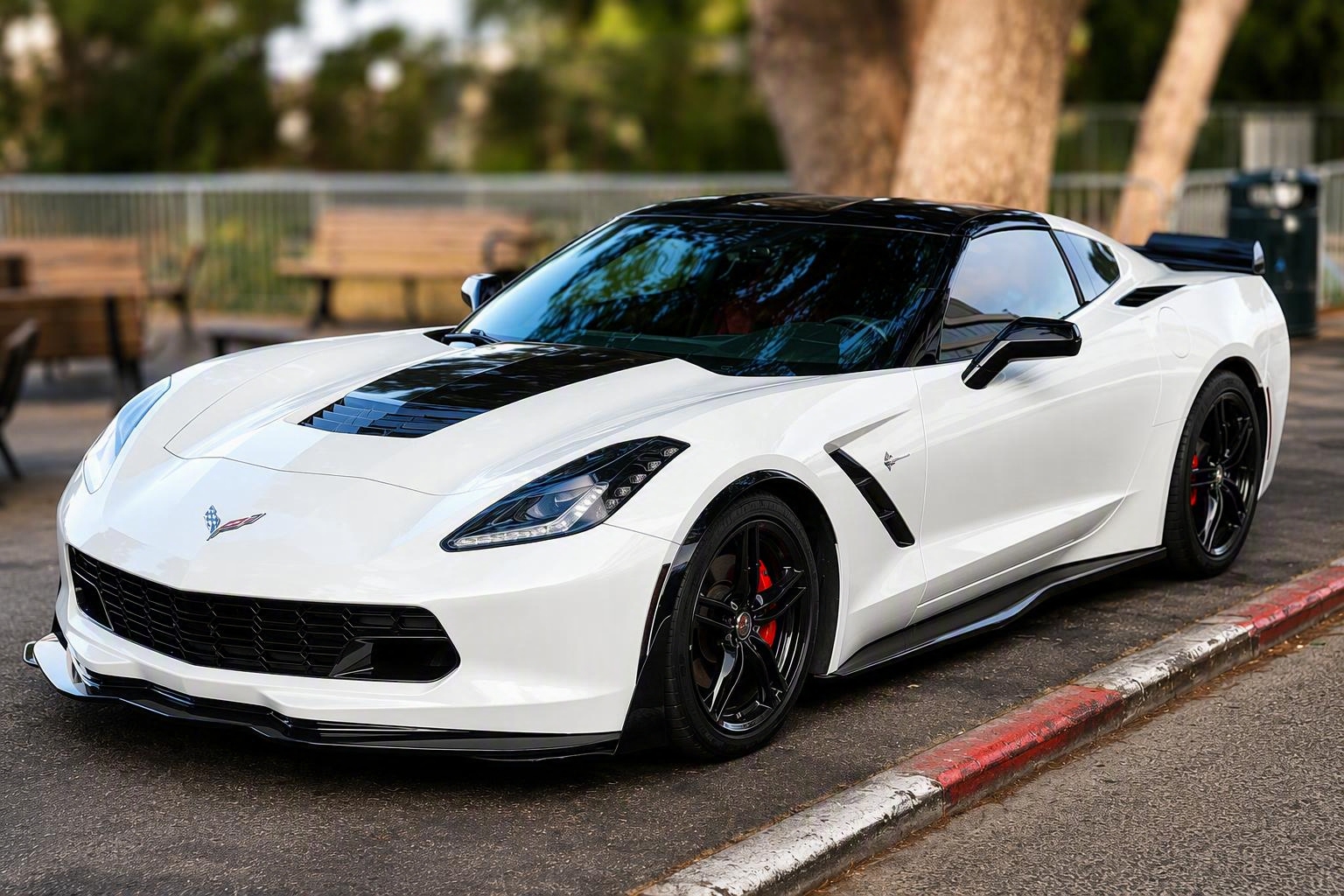
Park a C7 next to almost anything else from its decade and it still wins the staring contest. White over black, black roof panel, black wheels, red calipers behind the spokes. The proportions haven’t aged, mostly because Chevrolet stopped drawing Corvettes this way afterward and nothing has come along to make the shape look dated.
That’s the whole story of the C7 in 2026. It is the last front-engine Corvette. When the C8 arrived for 2020 with the engine behind the seats, a lineage that ran unbroken from 1953 just stopped. Cars don’t usually get a clean ending like that. When they do, the market eventually pays attention.
What the car actually is
Built from 2014 through 2019, the C7 brought back the Stingray name for the first time since the C3 dropped it in 1976. Under that vented hood sits the LT1, a 6.2-litre naturally aspirated V8 making 455 horsepower, or a few more with the performance exhaust. Direct injection, cylinder deactivation, variable valve timing. All of it in service of an engine layout that hadn’t fundamentally changed since the 1950s, which is part of the appeal.
The aluminium frame was standard across the range for the first time, not just on the top cars. The interior finally got fixed, which anyone who sat in a C6 will appreciate. And the seven-speed manual came with rev matching that actually worked, which matters more than it sounds like it should.
Then there was the Z51 package: dry sump oiling, bigger brakes, extra cooling, an electronic limited-slip diff, and the spoiler. Above that the Z06 with a supercharged LT4 at 650 horsepower, and at the very end the 2019 ZR1 with the LT5 at 755. Those two are already gone as far as cheap buying goes.
Why now
Base Stingrays have spent years as the bargain of the American performance world. A big naturally aspirated V8, a removable roof panel, real usable luggage space, and running costs that don’t require a second mortgage. People bought them, drove them, and nobody thought of them as future classics because there were plenty around.
That’s the part that’s shifting. The manuals are the ones to watch. Take rates on three-pedal cars were decent by modern standards but they still weren’t the majority, and every year a few more get traded for something with paddles. A manual Stingray in a good colour combination is a genuinely finite thing now, and the last one was built seven years ago.
The naturally aspirated engine matters too. No turbos, no hybrid assist, no supercharger whine. Just displacement and a throttle. Whatever replaces performance cars over the next decade, it isn’t going to sound like this.
If you’re shopping
A few things worth knowing. The eight-speed automatic that arrived partway through the run had torque converter shudder complaints in its early years, so check service history if you’re looking at an auto. Some owners reported cracking on the Z51 wheels. Track-driven Z06s had heat soak issues that Chevrolet addressed with revised cooling for 2017, so a hard-used early Z06 deserves a careful look.
Otherwise these are robust cars. The LT1 is a truck engine’s cousin and it behaves like one in the good sense. Parts are everywhere. Nobody has to hunt for a specialist.
The one in the photo has been given the full black treatment, splitter, rockers, mirrors, wheels, plus the aero pieces. Purists will grumble. It also looks fantastic, and the removable targa roof is still sitting right there on a car that will happily do a supermarket run.
The C7 spent its life being the sensible enthusiast answer. It’s about to spend the next decade being something else.