Number 26: The Fiat 124 Spider and the Long Argument for Undervaluation
The Fiat 124 Spider has spent most of its existence in the shadow of cars that were more expensive, more powerful, or more famous, and has spent the last two decades quietly becoming one of the more sensible investments in the Italian classic market. Rally number 26, a sage green Series 2 example photographed on the same Sicilian road as the Giulietta Spider that preceded it by a few car lengths, represents the argument for taking the 124 seriously on its own terms.
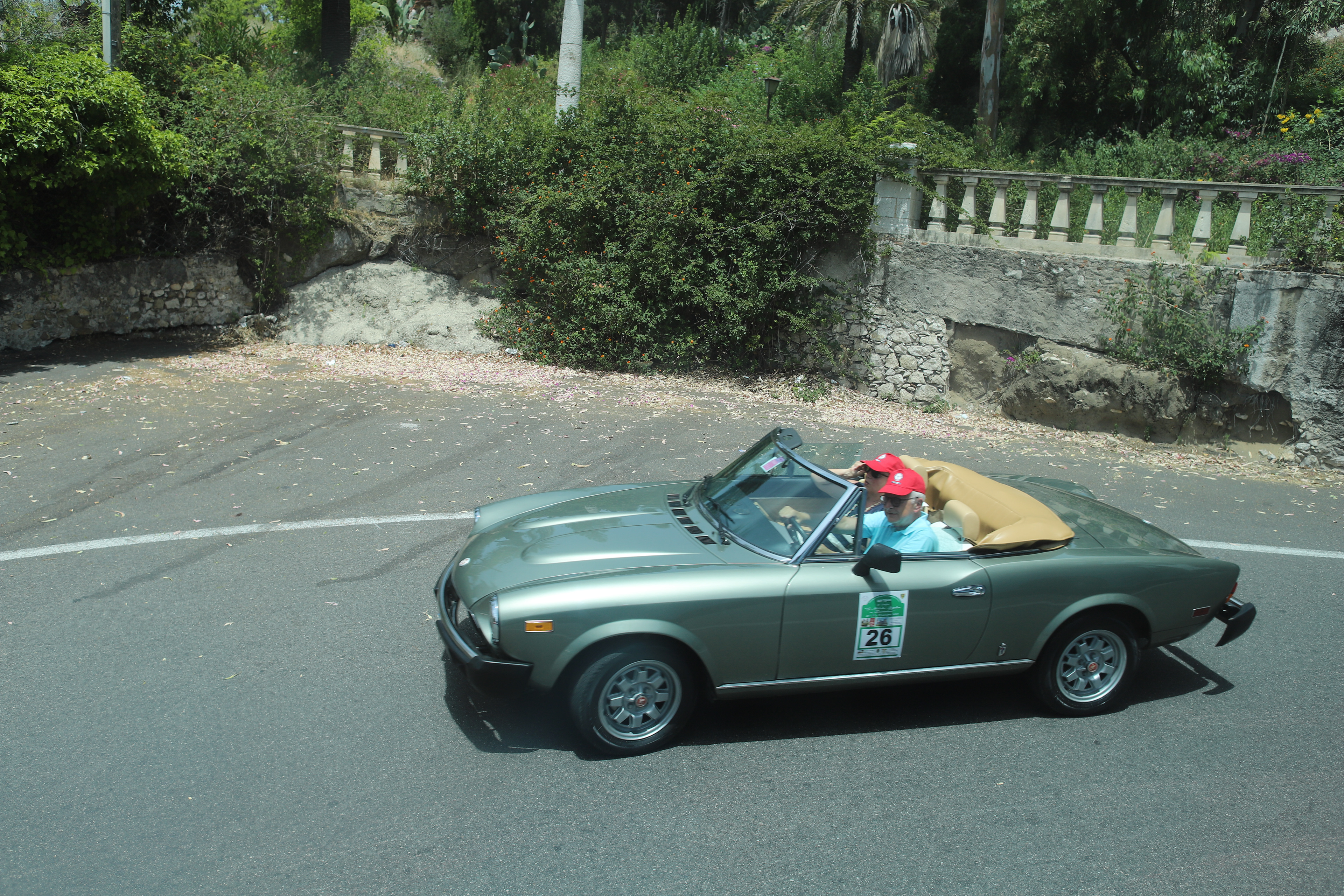
Pininfarina designed the 124 Spider body in 1966 and it entered production the same year, sharing a platform with the Fiat 124 saloon but wearing coachwork that bore no familial resemblance to its more prosaic sibling. The body is longer and lower than it has any right to be given what it was built on, with a clean shoulder line, a short tail, and a front end that manages to look purposeful without resorting to aggression. The design aged well across the car’s nineteen-year production run, which is a longer lifespan than most sports cars achieve, and the later Series 2 cars — distinguished by their revised front end, larger bumpers accommodating US regulations, and updated alloy wheels — are considered by some to have the better proportions despite the regulatory compromises involved.
The sage green on number 26 is correct. It is a color that reads as understated from a distance and reveals its complexity up close, which describes the 124 Spider’s character as well as any automotive metaphor can. The tan interior visible over the door sill completes the combination without straining for effect.
Mechanically, the 124 Spider was powered throughout its life by Fiat’s twin-cam four-cylinder in various displacements from 1.4 to 2.0 litres. This engine, designed by Aurelio Lampredi, was robust enough to form the basis for Abarth competition variants and reliable enough to survive the kind of casual neglect that Italian sports car ownership sometimes involved in the 1970s. The car was sold in the United States in significant numbers, which means that the supply of reasonably intact examples has always been better than the car’s reputation for rust would suggest. Many American-market cars came back to Europe.
What the 124 Spider never had was a compelling narrative. It was not the car of a famous film, not the choice of a famous driver, not the subject of a famous racing campaign. It was simply very good at being an open two-seat Italian sports car at a price that made it accessible, and it sold accordingly — over 200,000 units across its production run, which is an enormous number for a sports car of any era.
On a Sicilian road in summer, none of that context is required. The car moves through the corner, the top is down, the driver has the relaxed posture of someone who knows what he has. The long argument for undervaluation resolves itself into something simpler: it is the right car in the right place, and that is sufficient.