Number 46: A First-Generation Mustang Convertible on a Sicilian Road
The first-generation Ford Mustang does not require introduction, which is precisely its problem and its enduring strength. It is the most recognizable American car ever made — more immediately legible than any Corvette, more culturally loaded than any muscle car that followed it — and that familiarity creates a particular challenge for anyone writing about one in 2026. Everything has already been said. The numbers have been cited, the mythology has been deployed, the cultural significance has been processed and reprocessed through sixty years of automotive journalism.
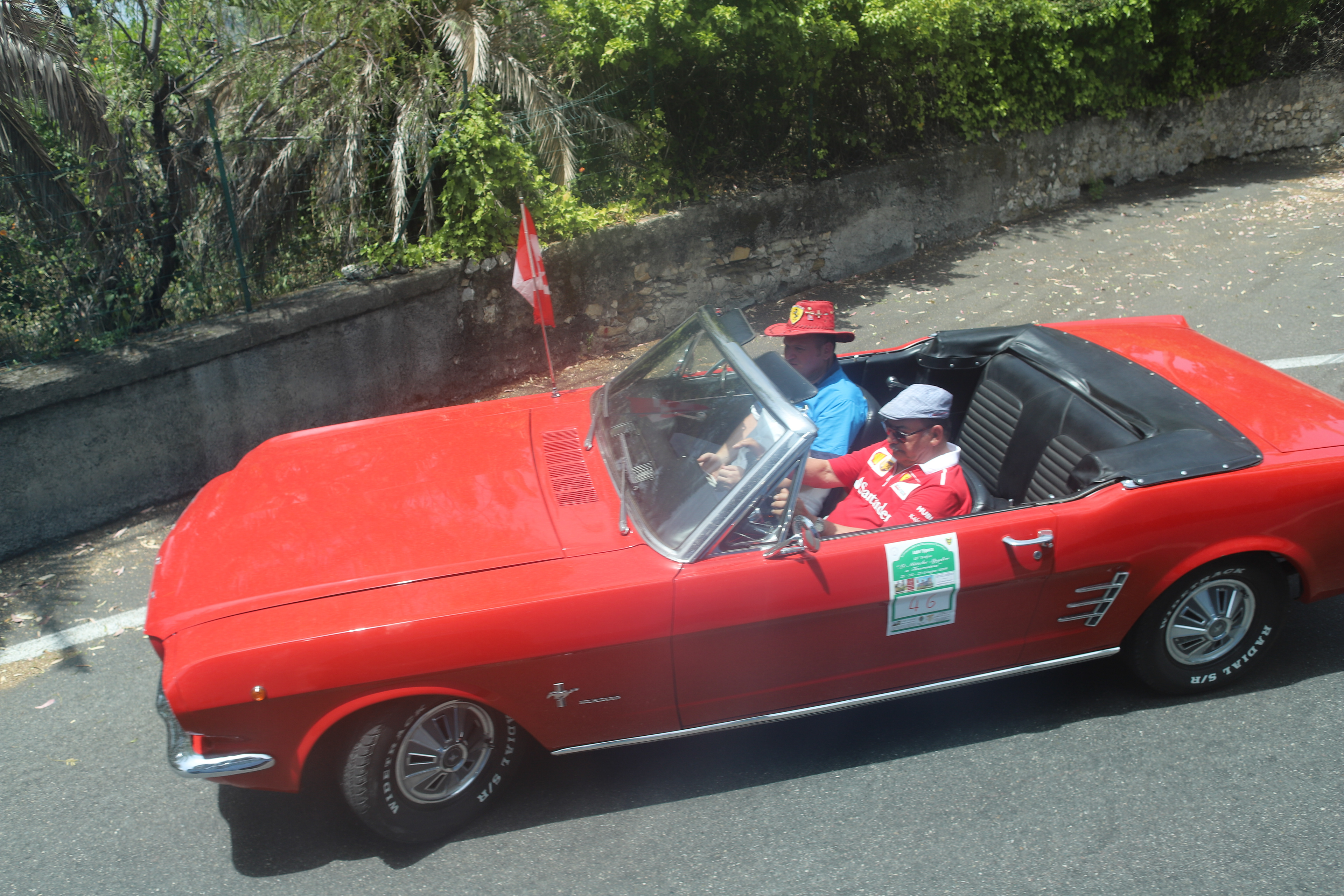
What remains, then, is the specific object in front of you. Rally plate 46, a 1965 or 1966 Mustang convertible in red, photographed on a Sicilian road during what appears to be the same classic touring event that produced the neo-classic Beauford a few cars ahead of it in the running order. The driver wears a Prancing Horse hat — Ferrari, not Ford, which is either irony or a statement about the driver’s actual loyalties — and the passenger has on a Santander-sponsored Ferrari shirt. Two men in a Ford, dressed for a different marque entirely. Sicily has its own ideas about what a car rally should look like.
The Mustang itself is correct in all the ways that matter. The long hood, the short rear deck, the chrome side scoop trim that does nothing aerodynamically and everything aesthetically. The five-spoke wheels are period-appropriate. The white-letter Radial S/R tires are the right kind of anachronistic — the sort of detail that signals a driver who has thought about the car without overthinking it. The top is down because the top is always down in Sicily in summer, and also because the Mustang convertible with its top up is a different animal: enclosed, ordinary, stripped of the silhouette that makes it what it is.
Lee Iacocca’s original brief for the Mustang was democratic: a car that could be ordered with enough options to be almost anything, priced to reach buyers who had been priced out of everything interesting. The 1965 convertible started at around $2,600. It was not a sports car by European standards — European standards being largely irrelevant to what the Mustang was attempting — but it was the fastest thing most of its buyers had ever owned, and it looked like considerably more money than it cost.
That gap between appearance and price has closed considerably in the intervening decades. A clean first-generation Mustang convertible now trades at multiples of what it cost new, adjusted or not for inflation. The democratization runs in reverse: what was mass-market is now collectible, what was attainable is now an asset class. The men driving number 46 through Sicily understand this. They are not driving a cheap car. They are driving an American classic on an Italian island with the wrong hats on, and they appear to be having an excellent time.
That is, in the end, what the first-generation Mustang was always for.