Red, Loud, and Unapologetically Fake: The Neo-Classic Roadster as Rolling Philosophy
There is a particular kind of car that makes no apologies for what it is. Not a survivor. Not a restoration. Not an original anything. It is a deliberate fiction — a vehicle engineered to look like the 1930s while being manufactured decades later, powered by something far more reliable than whatever supercharged straight-six would have powered the real thing. The neo-classic roadster has always occupied this odd, unembarrassed niche, and the red car photographed on a winding Mediterranean road — rally plate number 28 affixed to its door, two passengers leaning into a sun-drenched corner — belongs squarely to that tradition.
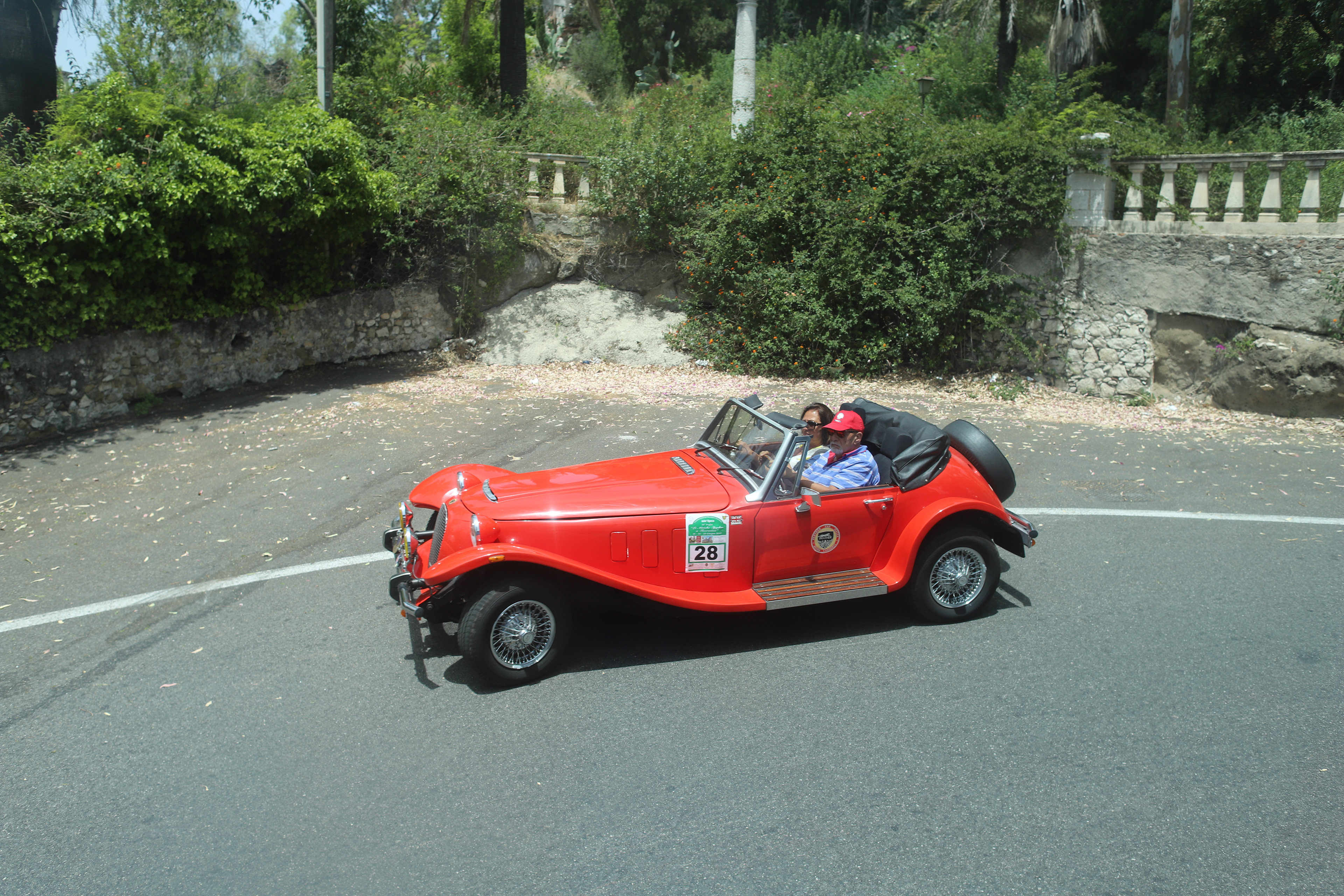
The car in question is almost certainly a Beauford Tourer or a close equivalent from the same 1970s–80s neo-classic movement. The evidence is in the details: dramatically sweeping front fenders that flow uninterrupted toward the running boards, a long bonnet that promises more cylinders than it likely contains, wire-spoke wheels that gleam against dark asphalt, and a rear-mounted spare tire that serves primarily as a visual statement. The convertible top is folded back, as it almost always is in photographs of these cars, because the whole point of a neo-classic roadster is the open air and the silhouette it creates against it.
The Beauford was a British kit car that found its audience among buyers who wanted the ceremony of pre-war motoring without the pre-war mechanical unreliability. Its spiritual cousins included the American Excalibur — a more famous and considerably more expensive proposition that drew on the Mercedes-Benz SSK as its visual reference — and a range of Brazilian-market replicas that borrowed the same aesthetic grammar for a different economic context. All of them were making the same argument: that the look of a thing has intrinsic value, independent of authenticity.
The rally context matters here. The green-bordered event sticker and the competition number place this on a Sicilian classic touring route — the kind of event that sends pre-war and vintage-inspired vehicles through the island’s interior and coastal roads at a pace designed for spectacle rather than competition. These events are not races. They are processions, and the neo-classic roadster is perhaps the purest expression of what a procession vehicle should be. It exists to be seen moving through a landscape. The stone balustrade and dense Sicilian vegetation in the background — agave, oleander, the dark columns of cypress — perform their own role in the composition. It is a backdrop the car appears designed for, even if it was built in Birmingham or São Paulo.
The passengers look comfortable. The driver wears a red cap and a blue shirt; the passenger has sunglasses appropriate for the light. Neither appears to be working particularly hard. That, too, is the neo-classic roadster’s promise: the aesthetics of effort without the effort itself.
Whether that constitutes fraud or wisdom probably depends on what you think cars are for.